Academic Screening Tools Chart Updated and New Supplemental Dyslexia Briefs Available
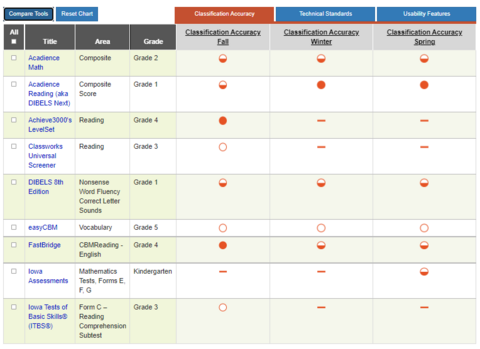
The Academic Screening Tools Chart provides information about assessment tools used to identify students at risk for poor academic outcomes who may benefit from additional support or intervention. It includes ratings for classification accuracy, reliability, and validity, along with information about sample representativeness, bias analyses, and key usability features. In the latest review of academic screening tools, 13 new tools were added to the Academic Screening Tools Chart and updated information for 20 existing tools. To learn more which tools were added and updated, view the Academic Screening Tools Chart – 2026 Update.
Did you know? Forty-nine states have passed legislation related to dyslexia. To support state and local leaders in meeting these requirements, NCII has developed a series of Supplemental Academic Screening Tools Chart Dyslexia Briefs. These briefs provide information on subtests that are part of academic screening tools on the Academic Screening Tools Chart designed to identify students at risk for experiencing reading difficulties, such as dyslexia. The briefs are organized by assessment suite and align with common state legislation requirements on the types of literacy skills that must be assessed in kindergarten through grade 2.
Available briefs do not represent all reading screening tools available on the Academic Screening Tools Chart. Vendors from the current tools chart were invited to provide information on the alignment of assessment subtests with the reading skills identified in the briefs using a standard template provided by NCII and developed collaboratively with the National Center on Improving Literacy (NCIL). Information on the quality of evidence for these subtests was reviewed by our technical review committee through our standard call for submissions process.